Turkish Researcher Uncovers Secrets of a Rare Iliad Manuscript
A Turkish researcher has published a study examining a rare manuscript of The Iliad, the famous epic poem by ancient Greek poet Homer. The manuscript is part of Sultan Mehmed the Conqueror’s personal collection, preserved at Istanbul’s Topkapı Palace.
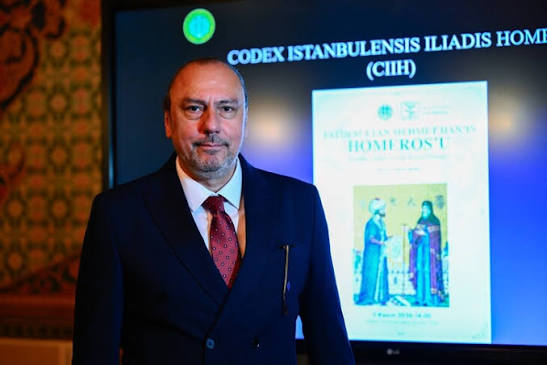
The research was conducted by Professor Hamdi Şahin, head of the Department of Ancient History at Istanbul University’s Faculty of Arts. After obtaining the necessary permits, he was able to examine the manuscript, which dates back to the 12th or 13th century. The copy had never before been subjected to a systematic academic study.
This is the first time the manuscript has undergone a detailed academic examination. The research uncovered several previously undocumented features, suggesting that it was produced in a specialized workshop operating in Istanbul during the Middle Ages.
The manuscript, which the research team has named the “Istanbul Manuscript,” consists of 260 folios. It measures 26.2 centimeters in length and 19.8 centimeters in width, and is bound in wood covered with embossed leather.
The inside of the cover contains records and notes revealing how ownership of the manuscript changed over time. One inscription in Ancient Greek indicates that it once belonged to the personal collection of Patriarch Gennadios II.
Researchers also found labels in French and Ottoman Turkish containing information about when the manuscript was copied and what it contains. These were accompanied by the stamp of the inventory committee at Topkapı Palace and official catalog numbers.
The manuscript begins on folio five with a biography of Homer, covering his family background, parents, and birthplace. This is followed by summaries of the different parts of the epic. The original text of The Iliad starts on folio seven and continues all the way to the final line of Book 24.
Each page contains between 14 and 30 lines of poetry, written in large, clear, and neatly arranged handwriting in the main text. The margins, meanwhile, contain explanations and comments written in smaller, more closely spaced letters.
The copyist used red ink for headings, decorative opening letters, and symbols referring readers to the explanations. The ends of words were also decorated with elaborate designs, abbreviations, and floral patterns, showing a high level of skill in manuscript production.
The explanations are not based on a single source but draw on several different references. This gives researchers a chance to trace how ancient texts and their interpretations were passed down through the centuries. The researchers also found wording differences compared with other copies of The Iliad, which may reflect language changes that took place as the text was copied over time.
The study also uncovered a carefully organized decorative system. It includes knots, interwoven patterns, horizontal red-ink bands, opening letters decorated with floral designs, concentric circles, and geometric shapes and drawings in the margins. These features were designed to separate different sections of the epic, make the text easier to read, and show connections between the various explanations.
The researchers used paleography, the study of historical handwriting and letter forms, to determine when and where the manuscript was copied. They also applied codicology, which examines the physical features of manuscripts, including their paper, bindings, page layout, and structure.
The findings showed that the deliberate use of different handwriting sizes was meant to distinguish the original text from the comments surrounding it. The consistent page layout, high-quality handwriting, and nature of the explanations all point to a specialized manuscript workshop in Istanbul, run by highly skilled copyists. The result was a carefully produced work combining the original epic with information about Homer's life and extensive explanations of its verses.
The research team believes the “Istanbul Manuscript” may be an intermediate copy linked to two well-known manuscripts dating back to the 10th and 11th centuries: Venetus A and Townleyanus, both preserved in Venice.
The study connects these manuscripts to the movement of Greek manuscripts from Istanbul to Italy during the 15th century, when Patriarch Bessarion donated his collection to the Biblioteca Marciana in Venice.
This theory is based on textual, linguistic, and explanatory comparisons, which support the possibility that the Istanbul copy served as a model for later manuscripts produced in the 13th, 14th, and 15th centuries.
The manuscript is considered particularly important because it is the only complete copy of The Iliad to have survived in relatively good condition. Although the edges of folios five and seven are damaged, researchers plan to restore the missing parts by comparing them with similar manuscripts.
Its place in the personal library of Sultan Mehmed the Conqueror, who captured Constantinople in 1453, and the fact that it has remained preserved in Istanbul give it unique historical and cultural value.
The research began in February 2026, while Professor Şahin was preparing an academic paper about Homer. He noticed what appeared to be a mistake in one of the words but could not find an explanation in modern editions. This led him to go back to the ancient manuscripts, where he discovered this rare copy, which he described as “a work unlike any other in the world.”
The manuscript has now been presented to the public for the first time.