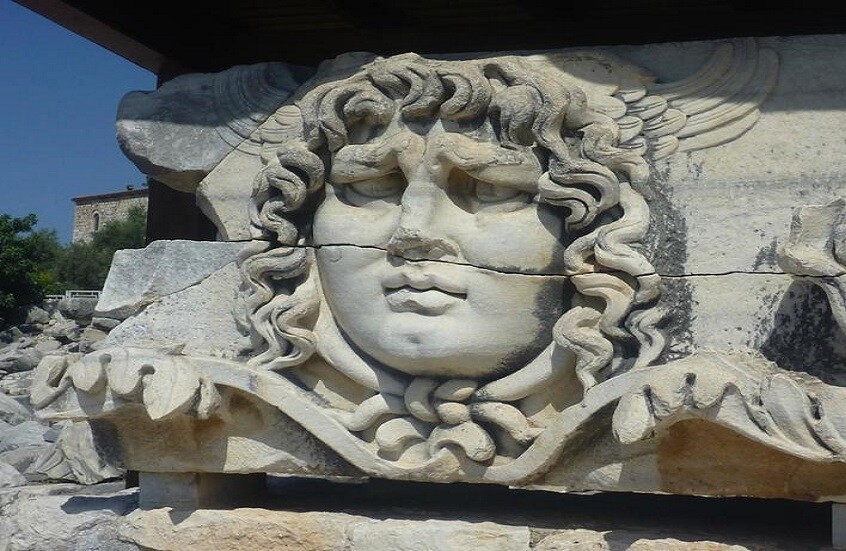
Smiling Marble Statue of Medusa Discovered in the Turkish City of Amasra
Archaeologists from Bartın University in Turkey have discovered a marble statue of Medusa in the ancient city of Amastris, known today as Amasra, in Turkey’s Bartın province.
According to Fatma Bağdatlı Çam, head of the excavation project, the statue stands out because Medusa’s face shows a gentle, unusual smile that almost looks childlike. She said it brings to mind Eros as a symbol of harmony and well-being.
“This is very rare in archaeology,” Çam explained. “Medusa is usually shown with snakes and a terrifying look that turns people to stone. But here, Medusa gives off a sense of calm.”
Çam added that in this context, Medusa’s image is linked to the idea of protection through beauty rather than fear.
Excavations are currently taking place at the Roman portico site, which covers an area of about 2,850 square meters. The site includes Corinthian columns reaching nine meters in height and was used in ancient times for meetings, trade, and public gatherings.
The complex is being restored using the anastylosis method. Three columns have already been reassembled, and four more are planned to be installed before the end of the year. The project is a joint effort between Turkey’s Ministry of Culture and the Turkish Petroleum Corporation, with participation from students and specialists from various universities.
Medusa, one of the most famous figures in Greek mythology, was one of the three Gorgons and the only one who could die.
She was originally a beautiful human woman and a priestess in Athena’s temple. After being assaulted by the god Poseidon, Athena became angry and transformed Medusa into a monster, turning her hair into snakes and giving her a gaze that could turn anyone who looked at her directly into stone.
Killing Medusa later became the mission of the hero Perseus. He used a shiny shield as a mirror to avoid looking at her directly, cut off her head, and from her severed neck were born the twins Chrysaor and Pegasus.
Perseus kept Medusa’s head as a powerful weapon, using it to turn his enemies into stone, and eventually gave it to the goddess Athena to place on her shield.
Historically and artistically, the statue is seen as a representation of female power and hidden danger within male-dominated myths, as well as a symbol of protection. This artistic theme has continued through the ages, from classical times to modern art.
Amazing Istanbul